The Origin Story of Bloomingfoods
By Ned Shaw
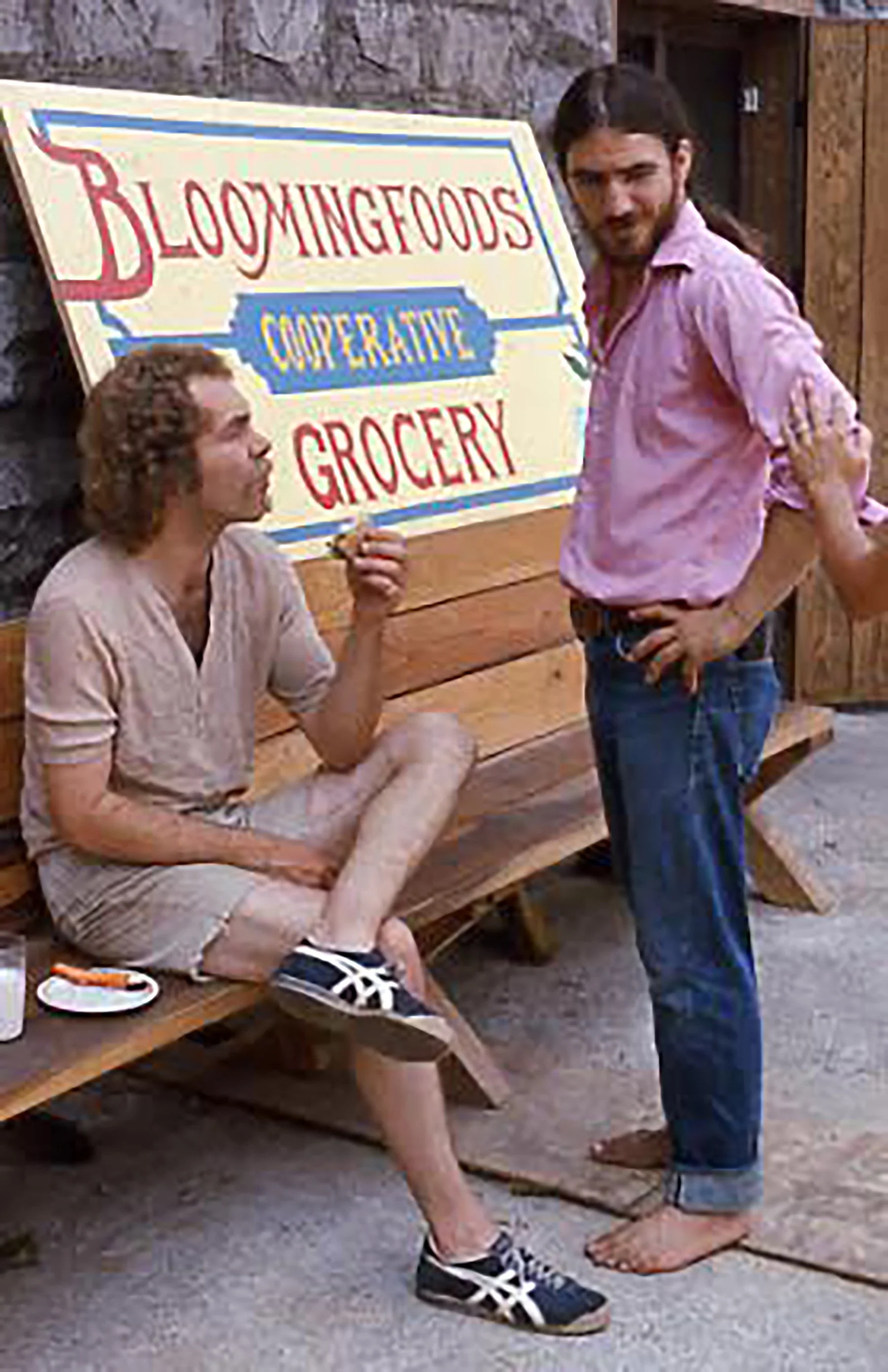
Ned Shaw and David Williams on Opening Day.
In fall of 1975, in the dining room of the Earth Kitchen restaurant on Kirkwood, David LoCascio asked me, David Williams, and David Greiser if we would be interested in creating a natural foods grocery store that would be cooperatively owned and operated and committed to selling real food and sustainable products.
He explained the vision: a ‘bricks and mortar’ store, as one would say now, as an alternative to the supermarket or the existing pre-order co-op. The pre-order group gathered monthly in a parking lot and divided up their collective order made weeks earlier of staples such as brown rice, whole wheat flour, peanut butter, canned goods and other natural staples unavailable at the supermarket. It took planning, was inconvenient, and had very little selection, but was the only way to get the whole foods we were all learning to eat as a way to better health.
Nowadays, of course, all sorts of natural foods, even organically grown, are easily obtained at several local supermarkets. I like to think that Bloomingfoods was a little part of that change, when we showed that was something people really wanted. But at the time, there was only one tiny natural foods store in town, The Clear Moment. It was in the basement of an art supply store off Grant Street. Its inventory was low, but its sincerity was high.
David LoCascio was a true visionary, and when he saw a need he went to work to address it. He and his wife Kyle had recently moved to town from Madison, Wisconsin, where he had been surviving mainly charting horoscopes for people. Upon arrival in Bloomington, he immediately started a newspaper called The Bloomington New Almanac. I first met him there when he published my cartoons in the paper. Soon, he worked with others to start the Farmer’s Market, hugely successful to this day. He also initiated an intentional community south of Bloomington called May Creek Farm, now home to its third generation of inhabitants. He always had two or three projects in the works.
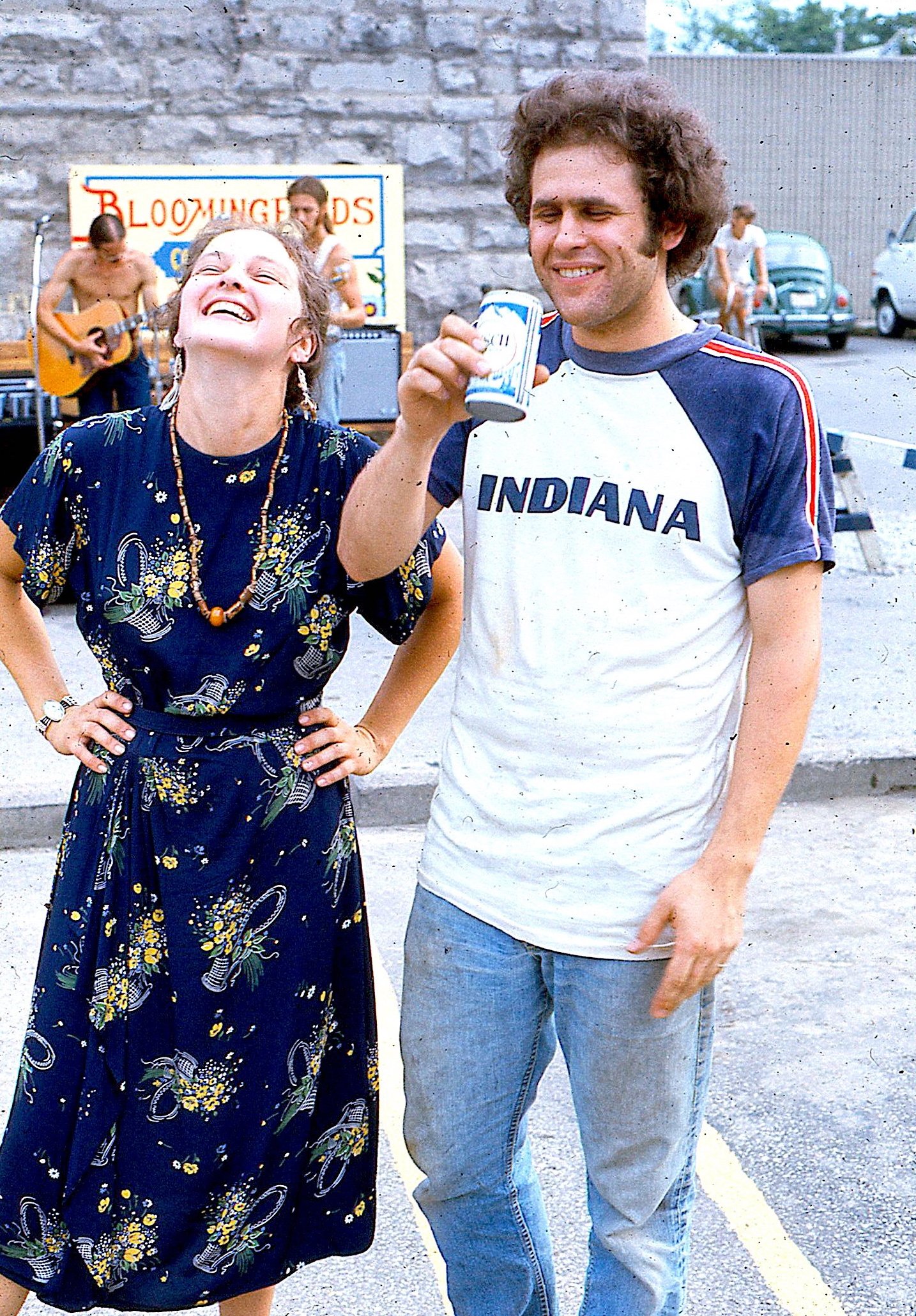
David LoCascio and Debra Fiscus on Opening Day. In the background, one of the original 4 managers, David Greiser (L), is seen on guitar, also Chip Pritchard on guitar.
David had made the acquaintance of Kathy Canada, an heiress to the Eli Lilly fortune and a prominent Bloomington philanthropist. For example, she owned the lot on Kirkwood, which even back then was called People’s Park, and eventually donated it to the city on the condition it never be built on or sold. She had a vision of how to make Bloomington a better place, and a commitment to alternative ways to see society. She and David, as well as many of us at the time, shared a dream of creating a counterculture that would meet our needs in ways that the mainstream did not. This included access to healthy food.
She had generously pledged $64,000 of her Eli Lilly stock as collateral for the loan that would purchase the Earth Kitchen restaurant and lease and renovate the old building behind it on the alley off Kirkwood. Bloomingfoods eventually paid off that note and Ms. Canada was never forced to sell that stock to cover our loan. We were all so proud on that day.
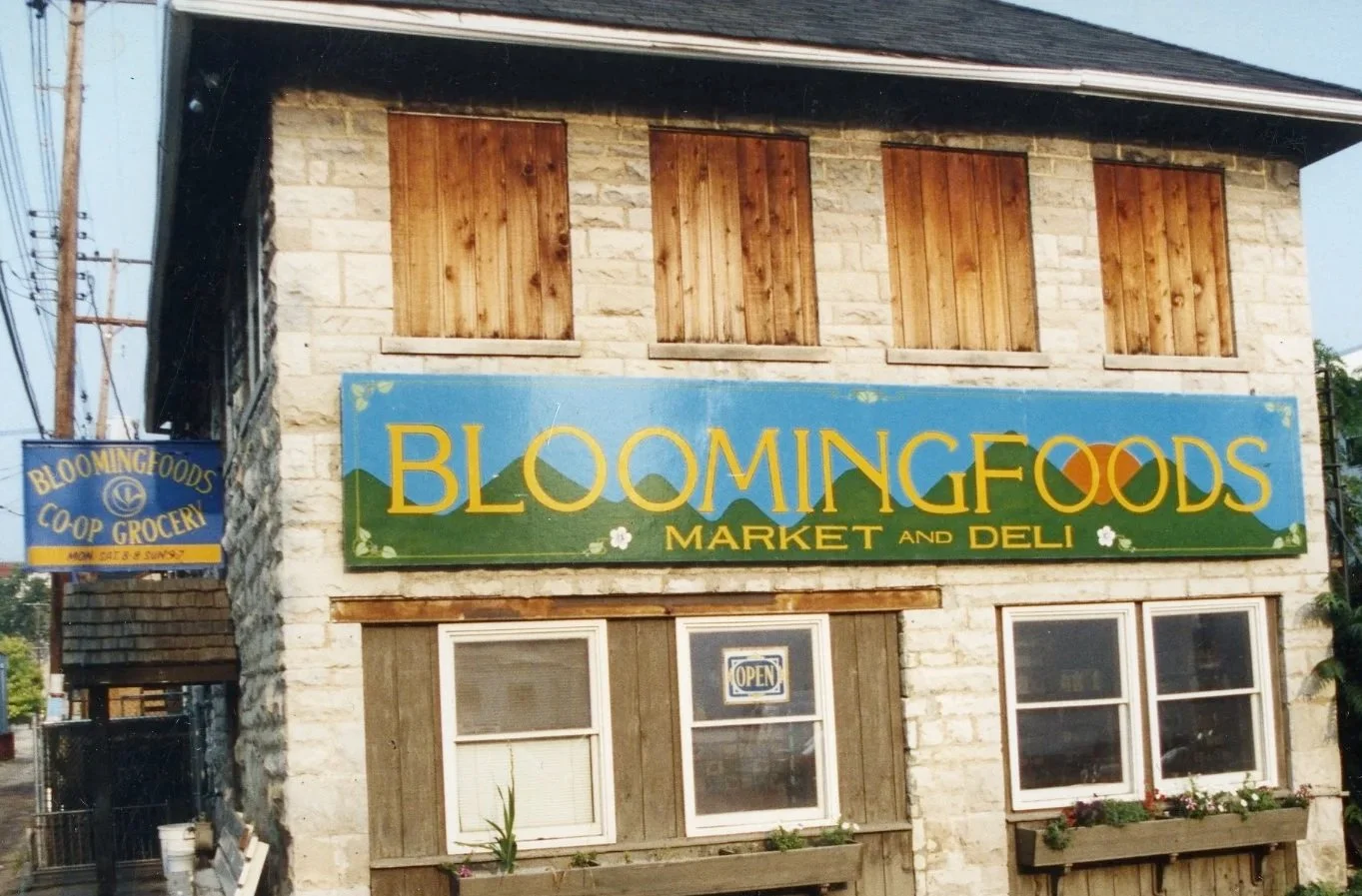
That loan gave birth to Bloomington Cooperative Services, still our corporate identity. (The Earth Kitchen lasted several more years but was destroyed in a fire.) The future Bloomingfoods, later known as the Kirkwood store, had previously been an auto repair garage, and before that, a livery stable. All it consisted of in 1976 was a two-story limestone block structure, with several windows, a rough wooden floor upstairs, and an old pizza oven in the back. It needed everything: the windows sashes were rotten, the upstairs floor was a splintered mess, and the downstairs floor was cracked concrete. A real fixer-upper!
On that day in the Earth Kitchen, LoCascio offered us this proposal: the co-op would pay each of us $75 a week, (which also included eating for free in the Earth Kitchen), and no health care, in exchange for unlimited labor and meetings. Of course we said yes!
So the four of us, an astrologer, a cartoonist, a saxophone player, and a tipi dweller, all broke hippies with not a lot of skills suited to this enterprise but lots of big ambitions, set to work pitching this idea to the students and townies who inhabited the Kirkwood area. We put up flyers and spread the word to come to the Earth Kitchen and be a part of something revolutionary: taking control of the food we eat. People were curious and showed up to hear what we had in mind. Inspirational talk was woven into the myriad practical issues needed to be worked out, and many people volunteered to help restore the building and work out the details of our business structure and guiding philosophy.
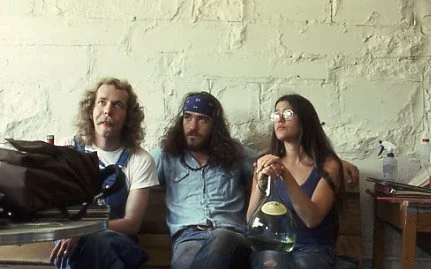
David Williams, Ned Shaw, and Susan Ewing at early Bloomingfoods strategy meeting.
There were scores of meetings that went long into the night, debating what we would offer and how we would govern ourselves. We studied other successful co-ops, primarily Ann Arbor, Michigan and Madison, Wisconsin, as models to follow, as well as the history of the cooperative movement in the US over the decades. I remember a few pivotal meetings where we faced major decisions. A primary one was whether we would be member-owned or worker-owned. With everyone already putting in long hours on the construction, there was a faction who strongly supported the worker-owned model because they feared losing control over what we were building. Others felt just as strongly that the whole point was to create something truly democratic that would reflect the needs of the members.
The debate centered around the fact that in those highly charged political times there had been some worker-owned co-ops whose political views had become extreme. Those stores had become mired in conflict over what to stock, and even who to allow to be members. To many of us, that seemed anathema to creating something to meet the needs of the community. This was about taking control over what we needed, not controlling what we thought best for others. I remember clearly the meeting about what food we would sell. One faction insisted we should never sell bananas because they were grown in dictatorships. Another said we should never sell cornflakes, because they had sugar in them, and sugar was bad. Others countered with the question of what if the members wanted those things, in addition to non-hydrogenated peanut butter and whole wheat pasta? And what about beer? Well, everyone thought we should sell beer, so no problem there! In the end it was put to a vote. We became member owned.
On the business end, we struggled with what membership meant. Originally the members received a discount as an incentive to join and could receive an additional discount by working a shift. This was a common practice in co-ops of this era, but to my knowledge most co-ops have moved away from this model. Possibly having a three-tiered pricing strategy was just too complex, not to mention the confusion it created in the mind of the shopper. The professionalism of having a paid staff eventually replaced volunteers who turned over constantly. But that didn’t stop us from exploring it. We just had to learn as we went along.
But what would we call the co-op? The night the name was to be decided, there was a spirited discussion, followed by a vote. People made suggestions, and often tried to shoot down ones they didn’t like. David Williams said “just vote for the one you like. There will be no negative voting.” I recall the two finalists were Bloomingfoods and The Good Deal Grocery. Yes, we are all thankful which name won.
While those discussions went on in the evenings, the days were filled with demolition, construction, hard labor and high energy. So many people came to help, all unpaid, all idealistic, all with generous spirits. They came from all walks of life…some looking to help, some seeking revolution, some just looking for wholesome food, but all willing to do what it took to make this dream a reality. It was inspiring, exhausting, and a fleeting moment in time. Looking back now, it all seems like sort of a miracle it came together so well.

Ned Shaw and his dog Zucchini on the way to work at Bloomingfoods. Photo by Tracy Rosen.
The weeks leading up to opening day were a whirlwind. We were running out of our capital and desperately needed to start generating money through food sales. In preparation, we needed to set up relationships with Eden Foods and other food suppliers, finish construction, make the initial food order, and oh yeah, we had to buy a cash register. So with a final push that nearly did us in, including dozens and dozens of volunteers working long days, we announced the grand opening. I sat on a bench outside the front door that day and signed people up to be members. I remember seeing the long line of soon-to-be shoppers. What an exciting, long-awaited moment.
Max Monts was there, our first Board Chair, who personally had spent hundreds of hours volunteering, including sanding and varnishing the upstairs floor. (We had a sock hop on it before installing the shelves!) Future Board member Susan Kornblum signed up, who was volunteering then as well as now. Nancy Lethem, who had been there from the first days, swinging a hammer and painting, now waited patiently in line, unaware that soon she would become the Head Manager and be charged with keeping this little ship afloat. There stood lanky Tracy Rosen, an MBA student at IU, who had helped write our Articles of Incorporation and our business plan. Rev. George Mitchell of the Methodist Church offered spiritual guidance and wry humor. Our three carpenters, Mike Yoakam, Daryl Dale, and John Kellam were all there, proud of what they had built. I saw a policeman I knew, and there was Frank McCloskey our mayor and future Congressman, chatting with Charotte Zietlow, City Councilwoman. It was coming true! We had created something that was pulling our beloved town together, under the banner of collective action and good vibes! Now if only it could last long enough to take root and become a permanent part of Bloomington.
–Submitted to Bloomingfoods in 2026, on the eve of our fiftieth anniversary.
About Ned Shaw:
Ned Shaw was an IU honors student who dropped out in 1972 to take part in the societal upheaval that had seized the hearts and minds of so many of his contemporaries. After traveling the country in a converted taxi, living out West and back East, and spending a couple of years in a small commune in rural Kentucky, Ned returned to Bloomington.
Life at that time seemed to revolve around the natural foods restaurants, bars, record stores, and coffee houses of Kirkwood. It was there he met David Locascio, who had published Ned’s cartoons in an alternative newspaper called “The Bloomington New Almanac.”
Together, along with many others, they started Bloomingfoods, as well as a land collective named May Creek Farm, and the Farmer’s Market. All three continue today after 50 years of building community and good vibes in Bloomington.
At one point during Bloomingfoods early years he read an article that said we fully replace our body’s cells every 7 years. (This actually is not really true, but whatever). He then realized he was made of Bloomingfoods!
Ned took his graphics skills, honed during the building of Bloomingfoods, into a successful career as a freelance illustrator and art director. He retired a few years ago as the Associate Vice President of Marketing Creative and Exhibit Design for the Children’s Museum of Indianapolis.